Friday, February 14, 2014

Interview with Syrian Ambassador to India (Rediff)


'Syria is central to Middle East peace'

February 14, 2014 14:45 IST
http://www.rediff.com/news/interview/syria-is-central-to-middle-east-peace/20140214.htmIn December, Ryan C Crocker, who has served as the United States ambassador to Syria, Afghanistan, Iraq, Pakistan, Kuwait and Lebanon, wrote in the New York Times, 'We need to come to terms with a future that includes Assad. A good place to start is Geneva next month and some quiet engagement with Syrian officials.'
That engagement will require at least listening to the Syrian point of view.
The Syrian government led by President Bashar al-Assad, whose family has ruled the nation for 44 years, has been involved in a violent civil war with insurgents since March 2011.
Despite repeated requests by the West, Assad has refused to step down.
A United Nations backed peace process -- comprising representatives of the Syrian government, the opposition and international mediators -- is underway in Geneva. So far, it has resulted in some relief being offered to refugees from the city of Homs.
In the days leading up to meetings in Geneva, H E Dr Riad Abbas, Syrian ambassador to India, explained the Syrian position to Cleo Paskal.
What is the situation on the ground?
It's on the record that America, with the support of Saudi Arabia, created Al Qaeda in Afghanistan to fight the Soviet Union. Al Qaeda members follow the culture of Wahabism. They think that if you don't believe what they believe, you are not a Muslim, and they have the right to behead you.
Now, Al Qaeda has spread all over the region and beyond, including Syria. At the 2012 Friends of Syria meeting in Morocco, Mouaz al-Khatib, at the time 'leader of opposition', refused to distance himself from Al Qaeda. He said that al-Nusra (which had openly pledged allegiance to Al Qaeda leader Ayman al-Zawahiri) is the main force in the Free Syrian Army.
On the ground, there is no Free Syrian Army, there is only Al Qaeda.
Who are the rebels in Syria?
They are all (members of) Al Qaeda. They are coming to Syria for Jihad. They are answering the call from al-Zawahiri, not from the Free Syrian Army.
Among them we have found at least 3000 European Union citizens, 70 Unites States citizens, and at least 6000 Saudis, including serving officers from the Saudi and Pakistani military. Some of the fighters are now spreading from Syria into Iraq and Lebanon. They will in time go back to their home countries, to the US, United Kingdom, EU, everywhere.
Who is supporting the rebels?
Turkey, with Saudi and Qatari money, and French technical assistance -- is the new base for Al Qaeda. How can the French fight Al Qaeda in Mali and support them in Syria? The West is fighting the very offshoot of what they are creating.
There are now two branches of Al Qaeda in Syria. One is supported by Saudi Arabia and one is supported by Qatar. America supports the Saudi faction. France and Turkey support the Qatari faction. The two factions are now fighting each other.
In January alone, fighting between the factions has killed thousands.
We have arrested Al Qaeda members who came to Syria from all over the world and they tell us they've gotten support from Saudi Arabia, Qatar, Turkey, and France. And, I am sorry to say, Israel.
Israel has been giving weapons and medical care to Al Qaeda fighters, and then sending them back to Syria to fight again. Israel has also allowed its territory to be used to let Al Qaeda fighters pass from one area of Syria to another.
I want to ask (Israel Prime Minister) Mr Netanyahu, does Saudi Arabia allow you to visit Medina? Is there a single church or synagogue in Saudi Arabia? Meanwhile, did anyone prevent you from coming to Syria? We were home to some of the world's oldest religious buildings of many faiths. Most have now been destroyed by those the West is openly backing.
In the Syrian Christian city of Ma'loula, one of the oldest cities in the world, they still speak Aramaic. Syria protected the city and its people -- for thousands of years it was safe. These people you are supporting destroyed it. How can Christian people support al-Qaeda that destroys their history and culture?

Syria is central to Middle East peace. There is no peace without Syria.
What is the West telling Syria?
America has only  one demand  -- get rid of His Excellency President Bashar al-Assad. Why didn't they ask for elections in Syria three years ago and let the people of Syria decide?
Without overwhelming support, including from the Syrian Sunnis, President al-Assad could not have stayed in power, especially during these three terrible years. America said change the leader now, ignoring the feelings of the Syrian moderate majority. Is that democracy? There can't be conditional democracy.
Why not ask for a change of leadership in Qatar, Bahrain or Saudi Arabia? Is there a constitution in Saudi Arabia? Are there elections in Saudi Arabia? Why no talk of democracy in these countries?

Syria is the only Arab secular democracy in the Middle East. It seems they want to replace a secular government with an Al Qaeda one. Syrian secularism is a challenge to religious fundamentalism in the region. And America wants to replace that with Al Qaeda leadership in the name of 'fighting terror'?
There is much coverage in the American  media about the suffering of those inside Syria, and  how Syria should remove its security forces to let in aid. But that would give free access to Al Qaeda and lead to still more deaths.
If the international community is concerned about the suffering of the Syrian people, why aren't they helping them in the places they control, like the refugee camps in Turkey? Syrian families are freezing and starving, and mothers, sisters and daughters are getting raped and trafficked into prostitution - under their watch.

What about the use of chemical weapons?

An American report has found that the Syrian government does not even have the sorts of weapon that was used in the attack that was the excuse to prepare for a strike on Syria. But Saudi Arabia does.
The fact is that [former Saudi Ambassador to the US, now Director General of Saudi intelligence] Bandar bin Sultan   provided them to his followers  on the ground in Syria. They used them against the opposition so the Syrian government  could be accused of crossing America's 'Red Line'.
We asked the international community to come in and check who used the chemical weapons.  They delayed. We gave the evidence to Russia to show at the UN Security Council.
Are there plans for an election?
Countries that value freedom must support us in our fight against Al Qaeda. How can we have elections with Al Qaeda terror on the ground? And how can we have democracy without an election? And how can it be a free election unless we can vote for any Syrian, including President al-Assad? Any government in the world has to protect its citizens and restore order. Once we have stability and security, we will have free and safe elections, with international monitors.
What are your thoughts on the Geneva negotiations?
In Geneva, America, France and Turkey will in effect sit down together with two Al Qaeda factions against a secular government. The Syrian  National Coalition sits in five star hotels outside Syria and has zero control inside the country. It is only a conduit for cash and weapons going to extremist fighters  fighters who behead innocent  for entertainment.
On the ground, there is only Al Qaeda. And this is how the West says it is fighting terrorism?
Our government will participate in Geneva, but we will not compromise with terrorism. National dialogue can only be between secular and moderate people who believe in human values. People who believe in the state.
Al Qaeda does not even believe in  Syria as a country. Without President al-Assad, Syria would disintegrate. That is Al Qaeda's game plan - to break apart Syria into Wahabi fragments.

http://www.rediff.com/news/interview/syria-is-central-to-middle-east-peace/20140214.htm

Tuesday, January 7, 2014

Article: The Importance of De-Hyphenating India (Huffington Post)

By Cleo Paskal. Western analysis of India is often blinkered by the "hyphen syndrome." First it was India-Pakistan, now it is India-China. But a recent conference in Pune showed exactly why that assessment is dangerously short-sighted, at the very least.

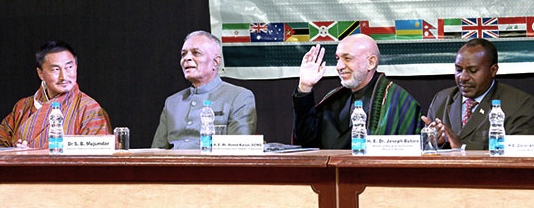
The India and Development Partnerships in Asia and Africa: Towards a New Paradigmmeeting, was held mid-December in Pune, India. It was co-hosted by the Indian Ministry of External Affairs and Symbiosis University. Symbiosis was an apt choice. The university has a large cadre of international students -- currently representing over 80 countries -- and the name derives from one of its founding principles: "Allowing various international cultures to culminate at a point and grow together".
The conference cast was impressive -- good thing Symbiosis has its own helipad. The Keynote on the second day was given by Afghan President Hamid Karzai. Also attending were Ambassadors and/or Ministers from, among many others, Bhutan, Burundi, Dubai, Gambia, Iraq, Mozambique, Oman, Senegal, Tanzania and Turkey . Each panel was chaired by a retired Indian Ambassador.
2013-12-30-Bhutankarzaiburundi.jpg
H. E. Lyonpo Rinzin Dorje, Foreign Minister of Bhutan; Padma Bhushan Dr. S. B. Mujumdar, Founder & President of Symbiosis; H. E. Hamid Karzai, President of Afghanistan; H. E. Dr. Joseph Butore, Minister of Education and Scientific Research, Burundi.
The message from non-Indians was overwhelmingly: "We already have strong relations with India, and we want even more." They weren't just being polite. The call was based on long-standing, multi-faceted relationships -- far beyond the soft power of Bollywood and small scale trade.
There is a genuine desire in a lot of the world to have an option that isn't the West and isn't China. So far, fractious internal politics in India have weakened the central government's ability to fully engage. But elections are coming up in 2014 and, if an effective government comes in, dynamics might change very quickly. A small sample of what was said at the conference shows why.
President Karzai underlined the millennia-old relationship between Afghanistan and India, even mentioning that Afghan cities were part of Indian consciousness as far back as theMahabharata.
And today, there is an enormous amount of fluidity between the two countries, including in education. In his address, Karzai said that while the West gives a good education: "In a dry sense, what they don't give is a moral value. And that is extremely important." Indian education is viewed as offering both. To widespread applause, he said:
India is not a melting pot which will assimilate you in their culture. Instead it will inculcate values and morals in you.
Currently there are around 4,000 Afghan students studying in Pune alone, and thousands more elsewhere in the country. Karzai himself earned his Master's degree in International Relations and Political Science from Simla University.
India, he said, had already given Afghanistan $2 billion in aid -- adding it was "quality" money spent on "projects of long term development and proper infrastructure," including transmission lines, the new parliament building, a hospital for children, a dam, etc.
He saw the Afghan-Indian economic relationship as potentially growing substantially, with access to the Indian market a boon for the Afghan economy, and Afghanistan being "a roundabout" for Indian access to Central Asia and beyond.
Other speakers echoed variations on the same themes. The Chairman of the Public Authority for Investment Promotion & Export Development of Oman also underlined the age old relations between the two regions (separated by a relatively short sea route) and said that Oman was going to be putting in billions in infrastructure -- including potentially arailway from Kuwait to Oman that would let cargo bypass the Strait of Hormuz -- and they wanted more Indian involvement.
The Foreign Minister of Bhutan talked of Nehru visiting Bhutan by yak before the highway was put in (with help from India), and of India continuing to be a key partner, and friend, for Bhutan.
The distinguished representative from Senegal asked the audience to stand in recognition of the influence that Gandhi, who lived for a time in South Africa, had on Africans, and on Mandela, before calling for the establishment of an India-Africa think tank to promote even closer ties.
Other African ministers mentioned the generations-old Indian communities in their countries, and the contributions they've made. As well as India bringing to Africa a range of critically needed products such as affordable medicine.
And on and on. All wanted more engagement with India, and said so in warm tones that Washington and Beijing could only dream of hearing. There was a feeling of genuine societal compatibility -- with deep roots and a strong desire for a growing future.
2013-12-30-iraqandindia.jpg
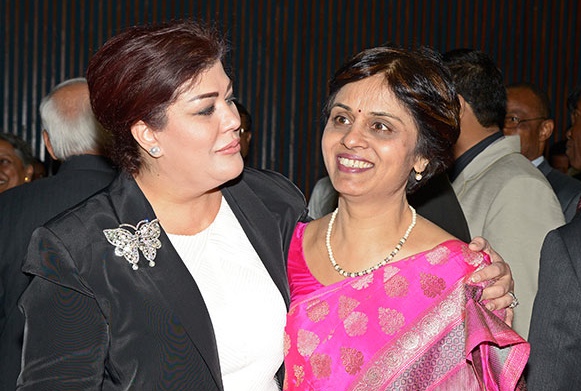
Hon. Safia Al Suhail, Member of Parliament, Iraq, and Dr. Vidya Yeravdekar, Principal Director, Symbiosis.
The Pune conference was not an isolated event, more another wave in a swelling tide as medium and smaller powers seek to maneuver through the perceived rocky Scylla of Western blunt force power, and the sinking Charybdis of economically and socially intruding Chinese influence.
Similar sentiments about India were expressed in November at Asia Uninterrupted, a high-level gathering co-hosted by Gateway House think tank and Manipal University.
Japan is also looking towards India with interest. Economic compatibilities are combining with concerns over China and a lingering doubt about U.S. willingness to engage in a war in Asia to defend Japan. India -- a nuclear state with hundreds of thousands of troops near China's border -- could present China with a distracting second front, if properly motivated. Perhaps coincidentally, not only has the Japanese Emperor just visited India after a lull of over half-a-century, but billions in Japanese investments are starting to flow in to the country as well.
Significantly, quite a few of these discussions are held away from Delhi, and without many participants from the West. I was the only ethnically Western speaker at the Pune conference (though I am working with an Indian university), and no one from the West attended the closed door meetings in Manipal.
These renewing constellations of alliances aren't a challenge to the West. India is a democratic, secular, education and family-focused, demographically young country with a lot of potential friends and a solid growth rate. From a Western point of view, a stable, successful and above all friendly India would be a sound ally heading into troubled times.
For the friendly bit, it means revisiting attitudes towards India, including the sort that produced things like the handling of the Devyani Khobragade case, House Resolution 417and the indignities meted out over the years to India's President, Defence Minister, UN Ambassador, U.S. Ambassador, and biggest film star. This has to stop. If only for the U.S.'s own sake. Apart from strategic considerations, if healthily engaged, India could help in understanding the concerns of sections of the world that are often underrepresented, including India itself, and be a valuable partner in growth as geoeconomics shift.
At the moment, India, in the sense of a strong national government making consistent, directed foreign policy decisions, seems a bit MIA. This may continue until at least after the elections. So, many of the linkages are being maintained informally by the business sector, education sector, health sector, people-to-people relationships, extended families, state-to-state engagement (for example, the Indian state of Gujarat reaching out to Gujaratis living in other countries), the Indian-American caucus (one of the largest on the Hill), etc. The links are there. And will grow. Regardless.
It is high time to ditch India's hyphen. The many complex parts that make up India are more like myriad overlapping hubs with myriad spokes than a single linear hyphen. India's place in the 21st Century is much more than just a counterpoint to China. No matter what happens in Delhi.

Tuesday, December 24, 2013

Video: Cleo Paskal at the East West Center, DC, on The New Battle for the Pacific: How the West is Losing the South Pacific to China, the UAE, and Just About Everyone Else (3 October 2013)

The New Battle for the Pacific: How the West is Losing the South Pacific to China, the UAE, and Just About Everyone Else from East-West Center on Vimeo.
Far from being small island states, Pacific Island countries are showing themselves as large ocean states, with vast fisheries, potential seabed resources, and increasingly important geostrategic positioning - as the range of military bases dotted throughout the region can attest. However, just as the region is showing its importance, Western influence is waning. When the larger Western powers pulled out of the region following the end of the Cold War (the United Kingdom, for example, closed three South Pacific High Commissions in 2006), they turned to Australia and New Zealand to "manage" the area for the West. Ms. Cleo Paskal discusses how and why this happened and what are the options for the West in this new battle for the Pacific.

Ms. Cleo Paskal is an Associate Fellow in the Energy, Environment and Resources department at Chatham House, London, and Adjunct Faculty in the Department of Geopolitics, Manipal University, India.

Recorded at the East-West Center office in Washington, D.C., October 3, 2013

Video: Cleo's Talk at the Trudeau Foundation's 10th annual Conference (22 November 2013)

Wednesday, July 17, 2013

Interview (DW radio, interview by Saroja Coelho): Europe is asking for a catastrophe


Cleo Paskal gives a presentaton at the conference Energy Security – How to Feed and Secure the Global Demand? held in Frankfurt am Main, Germany in July 2013. (Photo: Klaus Weddig)

INFRASTRUCTURE

'Europe is asking for a catastrophe'

Extreme weather caused by climate change threatens to ravage Europe's oldest cities. Cleo Paskal, an expert on geopolitical and environmental impact, says Europe is not facing the climate realities of the 21st century.
Deutsche Welle: Speaking at the Energy Security Conference in Frankfurt this month, you said we tend to focus on the impact humans have on the environment, but that we should also examine the impact our environment is having on us. What did you mean?
Cleo Paskal: We are in a world that is changing, not just for climate change reasons but because of population increases, depletions in groundwater, populations moving into increasingly vulnerable areas. What happened in New Orleans during Hurricane Katrina was the result of building on floodplains. It was a city in a hurricane zone that was hit by a hurricane. It was not a surprise. It created an enormous social, political and economic disaster, from which the region still hasn't recovered.
So, environmental change, and its effect on us, is being seen increasingly and in an accelerating way. This is going to change the way economies can sustain themselves, the way countries interact with each other and the way power is projected across the board.
A house is inundated by the Elbe river near the village of Fischbeck, in the federal state of Saxony Anhalt, June 12, 2013. (Photo: REUTERS/Thomas Peter)Large parts of Central Europe, including Germany, were devastated by floods this year
You have also said that European infrastructure and our policies are created without a sense of the world we are going to be facing in 20, 30 or 50 years. You've mentioned flooding as an example. You said it made sense 300 years ago to build in low areas near water, but that isn’t a good plan today. Could you explain?
Unfortunately, Germany just suffered some very tragic flooding. If you look at the towns, most of them are quite old, which means that they haven't been consistently flooded, otherwise they would have moved. Also, they were designed for a very specific time and a very specific place and a very specific population size - much smaller populations, more mobile and different climatic conditions. Very static conditions.
In most of Europe - and definitely Germany - our infrastructure and locations were chosen 500, 700, even a thousand years ago, that's how old the towns are. A lot has changed in that time but we haven't changed the locations which we put our infrastructure in. As a result, we are increasingly vulnerable as the variability comes. And it's not just the location but the population size. These towns were designed for 10,000 people, not 100,000 people. So, an already vulnerable location gets stressed more and more and that makes it even more vulnerable to disruption.
Paris, Maine, firefighter Stan Larson tries to keep his balance as he makes his way across debris to place a red sticker on a flood-damaged home in the lower Ninth Ward of New Orleans Saturday, Oct. 1, 2005. (Photo: ddp images/AP Photo/Charlie Riedel)New Orleans is in a hurricane zone. Eight years on, it is still recovering from Hurricane Katrina
So, you want people to start thinking about moving to safer spaces or building new cities rather than shoring up the ones that we have?
The insurance sector is starting to discuss this because they're the ones that have been picking up the bill. You are already starting to see places in the UK, for example, where houses just can't get insurance any more. If you can't get insurance, you can't sell your house.
They're not getting insurance because they're vulnerable to catastrophes?
Because they flooded. In fact, in the UK they built houses on floodplains. The sellers said, 'we guarantee you can get insurance'. So homeowners got the insurance and when they flooded, they got the payout. But then the insurer said once is enough and we're not going to pay out again. Now homeowners are stuck with houses on a floodplain that they can't get insurance for. This isn't one or two cases – this is potentially tens of thousands of cases and increasingly more across Europe as the floodplains change and increase.
What conversation would you like policymakers to have?
I'd like them to have real discussions about risk, where risk isn't discounted, distorted or diverted into other factors. If a place is too dangerous to build in, don't back it with federal insurance. Let the market say this is too dangerous to build in and just pull out.
This is a problem across the western world. This is why the US national flood insurance program is consistently bankrupt: because the market has said it's too dangerous. But the government has said but we want the tax revenue from the beachfront properties. So they push the risk of the flooding off onto the global or the state-wide taxpayer by providing federal flood insurance. By discounting, distorting or diverting risk into other areas, we're getting a very unreal sense of the vulnerabilities in our systems.
Picture of Paris with the Eiffel Tower shown in the background. (Photo: Fotolia/ThorstenSchmitt #28290547)Are cities built hundreds of years ago prepared for the realities of the 21st century?
How does Europe perceive this?
Europe thinks this is mostly a developing world problem but it's not. Actually the countries with the oldest, most static, least adapted infrastructure are the old Western countries like the ones in Europe. This infrastructure is hundreds of years old, it's for a different time. Also, the population expects a very high level of responsibility from the government, whereas in places like India people have generators at home because they know not to rely on the government. If their house floods out they have friends they can stay with, the social networks are extremely strong. So if Europe thinks that it's in a better position than the emerging world, it really needs to re-think.
Cleo Paskal is an associate fellow at Chatham House, the Royal Institute of International Affairs in London, and an expert on geostrategic issues. She is the author of 'Global Warring: How Environmental, Economic, and Political Crises Will Redraw the World Map'.
Interview by Saroja Coelho

Tuesday, July 9, 2013

Article: Business As Usual Is Finished (energlobe.eu)

Why the "3 Geos" create new global paradigms
CLEO PASKAL | 9. JULY 2013

Ensuring energy security is becoming more and more complex. Energy flow is coming from a wider range of suppliers and technologies, but is still often linked together and delivered by massive, inflexible infrastructures. Any variability in the systems that support the financing, extraction, refining, generating and distribution of energy can disrupt supply. Disruption to supply can have serious economic, political and social implications. Where it is getting increasing tricky is that those supporting systems are being caught up in larger, global shifts.

Geopolitically, Russia, for example, is using petropower and nuclear expertise to affect its negotiating potision with its political allies and foes.

Meanwhile, geoeconomically, the rise of China is resulting in Chinese companies taking up enormous stakes in oil and gas fields around the world, while at the same time it is using its domestic economic policies to gain market advantage in areas such as solar.

And, from a geophysical point of view, changes in the physical environment of the planet (including natural disaster, climate change, shifting demographics, etc.), are increasingly affecting energy distribution and usage. In the past month alone, massive floods triggered major power disruptions in Germany, Alberta and India, and immense forest fires affected supply in Arizona and Quebec.

We are shifting towards a more multipolar world, with the economic balance of power gravitating towards Asia, and with major shocks triggered by environmental disasters (such as Fukushima, super-storm Sandy, and the increasingly costly typhoons hitting China’s east coast). If we want to keep the lights on (literally), the changes in the “3 geos” (the geoeconomic, geopolitical and geophysical) are forcing us to reevaluate existing systems.

Friday, June 28, 2013

Quoted in Time Magzine about Ethiopia's dam on the Nile


Quoted in 'Ethiopia’s Plan to Dam the Nile Has Egypt Fuming', by William Lloyd George. 

Excerpt:

In spite of the uncertainty surrounding the dam project — and its potential to create friction in the region – it could ultimately turn out to bring greater harmony to the countries through which the Nile flows. “If transparency is increased then this dam can be a great opportunity for the region to work together,” says Cleo Paskal, a specialist in water and food security at London’s Chatham House think tank. “Ethiopia will now be a stakeholder of the Nile and it will be in all the countries’ interests to increase dialogue and to protect the river in a way that benefits all.”


Friday, June 21, 2013

Interview (radio): Cleo on a German documentary about water resource tensions


'Der Kampf um die Ressource Wasser' broadcast by Deutschlandradio can be heard here. Cleo is quoted as saying:

"Das Projekt ist Ausdruck größerer geopolitischer Verschiebungen in der Region."

[...]

"Der politische Status quo in der Region hat sich nicht nur durch den arabischen Frühling massiv verändert - auch neue Akteure spielen eine Rolle, beispielsweise China. Der Staudamm ist daher nur eine von vielen Veränderungen in der Region. "

[...]

"Somalia zerfällt. Der Sudan ist inzwischen geteilt. Und Ägypten hat mit seinen eigenen Problemen zu kämpfen. Dank der Schwäche der anderen kann Äthiopien seine Rechte am Nilwasser stärker einfordern."

Your guess is as good as, no better than, hers as to what it means.

Wednesday, June 19, 2013

Quoted in Financial Times on Ethiopia's dam on the Nile


From, 'Water: Battle of the Nile' By Katrina Manson and Borzou Daragahi.

Excerpt:

“This is about Egypt being weakened and Ethiopia becoming stronger in comparison,” says Cleo Paskal, a water security expert at Chatham House, the London think-tank. [...] 

But a piecemeal approach will not resolve the deeper regional imbalances. “This colonial-era paradigm is locking conflict into the system,” Ms Paskal says. “Unless it’s broken out of, it will just get worse and worse.”

Monday, June 10, 2013

Interview (radio): Cleo on Background Briefing talking about IEA report and strategic issues

To hear Cleo interviewed by Ian Masters on Background Briefing about everything ranging from super storm Sandy to global security, click here.